
How to Search Cases by Name
Michigan runs its statewide public search through MiCOURT Case Search. The name path starts with a last name or business name. You can add a first name, middle name, or birth year to narrow things down. Keep the field combination as small as it can sensibly be. A broad name search may pull back more than one person or business, and what the public sees still varies with court participation, case status, and access limits.
- Open MiCOURT Case Search and choose the name search path.
- Enter the last name or business name, then add first name, middle name, or birth year only when available.
- Review the court, case type, filing date, and public status of each likely result.
- Open the matching public case history and record the court and case number before requesting an official record.
| Field label | Type | Required | Public-path note |
|---|---|---|---|
| Last name or business name | Text | Yes for the name path | Start with the exact spelling available. |
| First name | Text | No | Use to narrow a common surname. |
| Middle name | Text | No | Use only when known and relevant. |
| Birth year | Year | No | It can help distinguish results without entering a full birth date. |
| Court or case details | Selection or result information | Varies | Availability changes by public record and court participation. |
Osceola County Case Lookup Name Fields
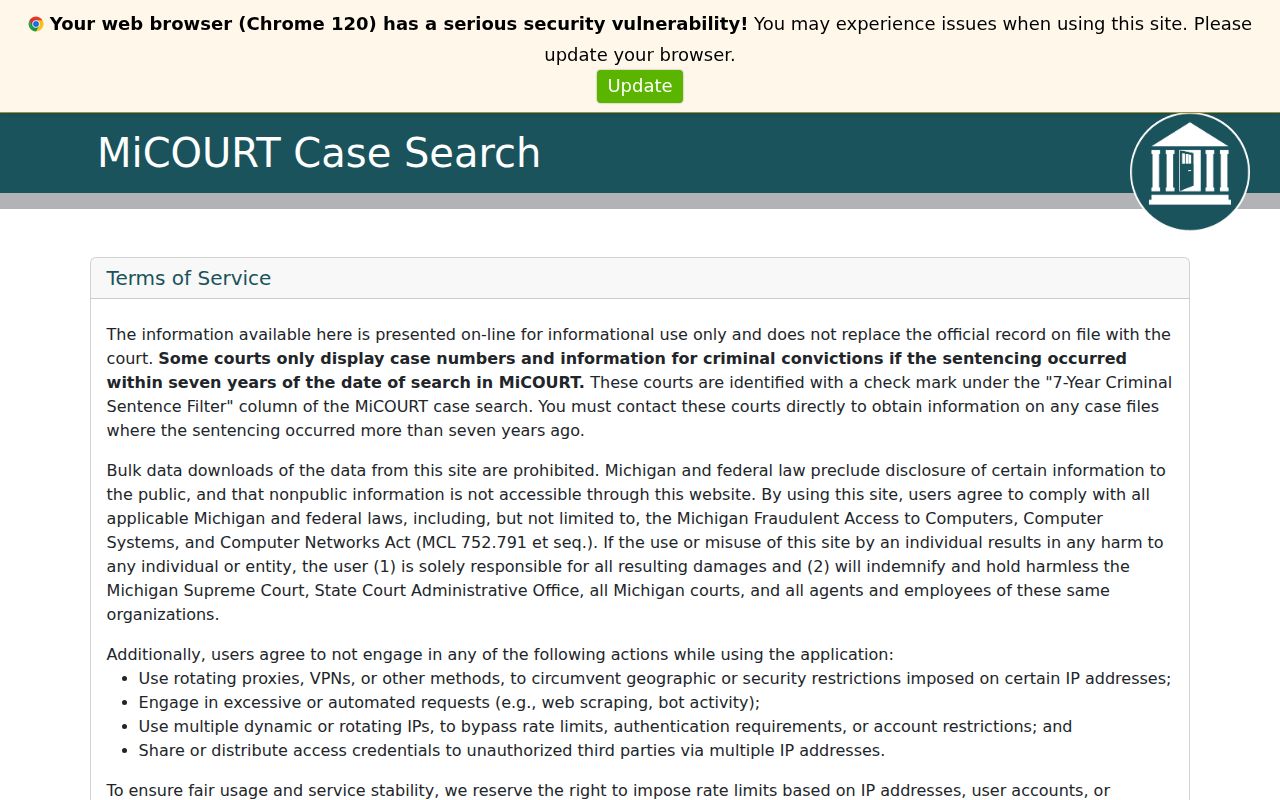
The MiCOURT landing page labels the service informational and points users to the court of record for anything official. Treat results there as a starting point, not a certified record.
Common names make mismatches easy in an Osceola County case lookup. Before trusting a hit, compare the court. Compare the case category, the filing date, and the case status too. Never send a full protected identifier through an ordinary message just to sort out two similar names. The clerk can tell you whether a public court record exists and can be released. What no clerk can do is turn a restricted case into a public search result.
How to Search by Case Number
MiCOURT builds its case-number path from three parts: year + number + type. Copy those components exactly as they appear on your notice or case history. No single Osceola example fits every court and category. So work from the notice rather than guesswork. Precise components help both the portal and the clerk separate matters that share a name. Enter the parts exactly as the public interface asks. Then check which court appears on the result. A case number beats a name for precision. Even so, it cannot force the public interface to display every event or document. Keep the court name and search date handy in case the record needs follow-up.
Osceola County Case Lookup Courts
Picking the right court keeps a case lookup from dead-ending at the wrong door. The 49th Circuit Court is the general-jurisdiction court for Mecosta and Osceola Counties. In Reed City, the 77th District Court handles district civil matters, misdemeanors, preliminary felony hearings, traffic cases, and civil infractions. Estates, guardianships, mental-health matters, adoption, juvenile proceedings, name changes, and related probate cases belong to Probate District 18. MiFILE's court directory publicly lists the Osceola County Reed City 77-2 District Court. That listing covers electronic filing, though. It does not guarantee a public case-search result for every case. Results still depend on the court, the public status, and the case type.
What a Case Search Shows
A public case lookup can return the identifying details plus a running history of public events. MiCOURT's official documentation lists the data concepts it tracks: case number, year, type, category, subcategory, caption or entitlement, public status, case status, filing date, disposition, closed date, judicial officer, participants, attorneys, and next hearing. Expect the public screen to show fewer fields than that list.
| Case number | Identifies the court case and can be used for a more precise follow-up search. |
|---|---|
| Caption or parties | Names the case or public parties where the record allows display. |
| Case type and category | Helps distinguish civil, criminal, traffic, domestic, probate, and other court paths. |
| Filed date | Shows when the case entered the court system, not necessarily when the underlying event happened. |
| Status and public status | Indicate whether the case is open, closed, disposed, or publicly displayed. |
| Event history | Can include filed events, hearings, orders, disposition, or next hearing when public. |
A case history is not a certified copy. Nor is it the whole case file. If you need an order, a pleading, a register of actions, or a certification, ask the clerk for that exact record product by name.
Osceola County Case Lookup Result Terms
Short status labels invite misreadings. Each term marks a different point in a case history, so read every label alongside its event date and its court before drawing a conclusion.
- Case category
- A broad grouping such as criminal, civil, traffic, domestic, or probate.
- Subcategory
- A narrower classification within the case category, when the public system exposes one.
- Filing date
- The date the case was filed with the court.
- Disposition date
- The date the court recorded an outcome or disposition event.
- Closed date
- The date a case was marked closed, which can differ from a disposition date.
A public status only says what the system may display. It promises nothing about documents. The clerk can confirm access to a particular public record.
County vs Statewide Case Search
MiCOURT offers a free, statewide, informational starting point. Osceola County's published 49th Circuit name-search service works differently: a clerk performs the search for you rather than a self-service county portal. Choose based on your goal, whether that is locating a possible public case, confirming which court holds the record, or getting a specific record product.
| MiCOURT statewide search | Osceola County Clerk route |
|---|---|
| Public informational index for participating court records | Clerk-performed criminal or civil 49th Circuit name search |
| Free basic public search with name or case-number paths | $5 per name, according to the county's published instruction |
| Useful for locating a public case history and court | Useful when an identified 49th Circuit search or register of actions is needed |
| Does not replace the official court record | A register of actions copy is listed at $1 per page after a found search |
Osceola County Case Lookup Clerk Route
The County Clerk's criminal or civil name-search instruction explains the local 49th Circuit route and lists the prices for the search and the register of actions. Read it before you send a request.
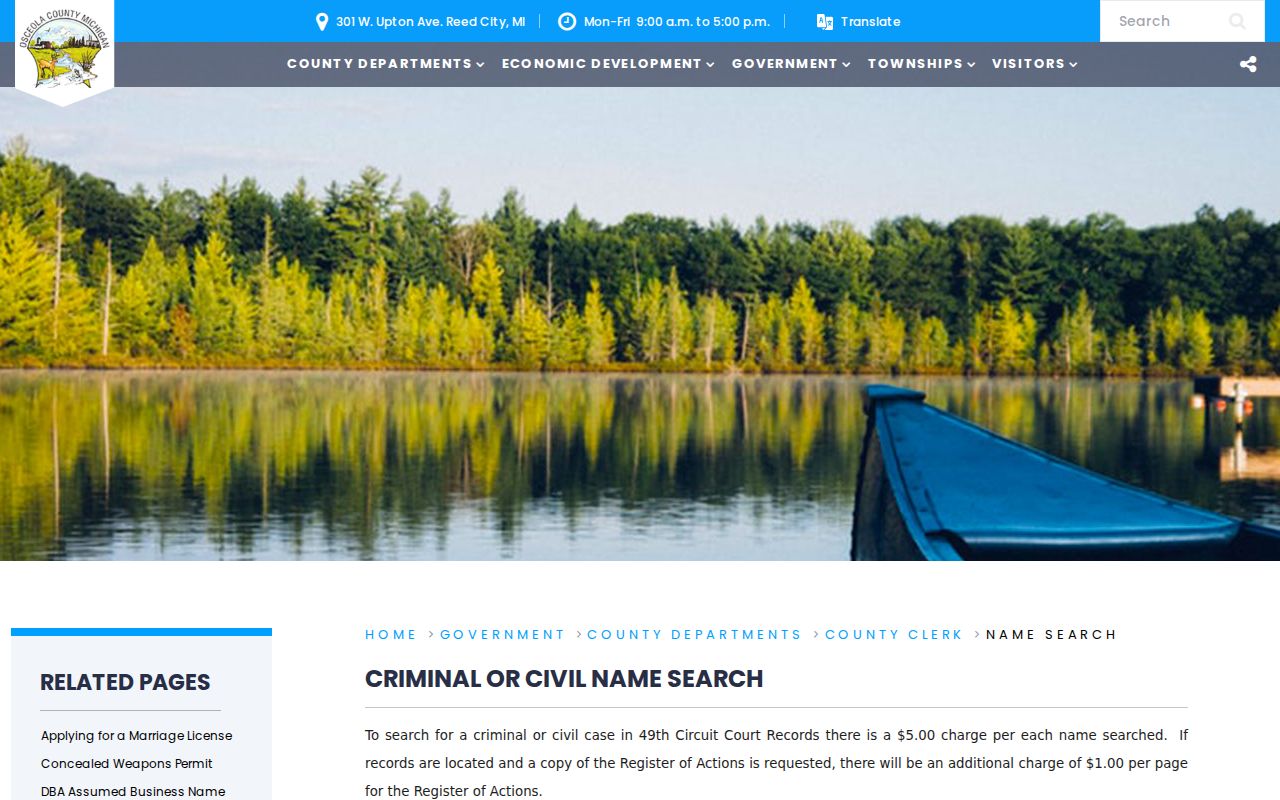
This is not an online case-search form. It is a request for the clerk to run a name search on your behalf. When you contact the clerk, state the court. Give the name or case number, and the case type if you know it. Say whether you want a public register of actions, a plain copy, or a certified copy. The county publishes no processing-time promise for the service.
Restricted Cases and Access Rules
Michigan's public search notice spells out categories that never display publicly. The list includes adoption, juvenile and child-protective proceedings, juvenile guardianships, mental-illness proceedings, name changes, parental waivers, PPOs, surrendered-newborn-child cases, certain disease proceedings, PPO violations, extreme-risk protection orders, young-adult voluntary foster care, and wills. Family and probate access can also hinge on the document, the party's status, and a court order. MCL 712A.28 limits general-public access to juvenile records. A sealed record is not the same thing as a search error. Under MCR 8.119, a court may seal particular material. It can keep its order or opinion public at the same time. A public docket entry and a restricted attachment can sit side by side in the same case.
Osceola County Case Lookup Missing Results
When a MiCOURT search comes back empty for an Osceola County name, several things could be going on. A broad or misspelled name hides results. So does a case filed in a different court. Public status may limit what displays, and some case types are left off the public portal entirely. Criminal conviction entries also fall under MiCOURT's seven-year sentence display notice.
Narrow the docket search with the court, the case number, the case type, or the name fields you have. Still nothing? Call the court of record before assuming the matter was dismissed or never filed. For a 49th Circuit criminal or civil docket, the published County Clerk route is the documented local fallback.
Osceola County Case Lookup Official Proof
Treat a MiCOURT result as an informational public index. It is not official proof of a case record. MCR 8.119 keeps the clerk responsible for the record while opening case histories and documents to the public. Anyone may inspect a public case history without an access fee, but reproduction and certification are separate matters.
For an official product: ask the clerk for the particular record, such as a register of actions, order, judgment, plain copy, or certified copy. The County Clerk fee page lists a certified court copy at $10 plus $1 per page and a plain copy at $1 per page. Confirm the court and product before paying.
Michigan court records answer to the court rules, not to a county FOIA request. The governing sources are MCR 8.119 and MCR 1.109.
Osceola County Case Lookup Filing Layer
MiFILE's available-courts directory lists the Osceola County Reed City 77-2 District Court among its courts. MiFILE is an account-based electronic filing service. Filing is its job, not public case-history searching; the docket lookup layer stays with MiCOURT.
The county's 77th District page tells attorneys to file civil matters through MiFILE. Self-represented parties may use it too, though they are not required to. That local filing rule promises no public online case access through MiFILE.
Osceola County Case Lookup Calendar Link
Sometimes the question is a date, not the full case history. For that, turn to the public MiCOURT Court Display. Its rows run by date and show party name, time, room, and case number. Grab the case number. Jump back to case lookup. Call the court to confirm any setting that matters.
A calendar line is not a disposition or a complete docket. The public display changes, and restricted matters can be missing from it. The site's Court Dates page lays out the date-focused route. It helps once the right court and case are known.