
Getting Osceola County Court Records
Two things unlock any Osceola County court docket request: the right court. The right item matters just as much. Start with the public MiCOURT case search or the case number printed on a notice. Then figure out where the file sits. It could be the 77th District Court, the 49th Circuit Court, Probate District 18, the family division, or a federal court. The clerk needs that identification first. Only then can the clerk locate the official file or apply the correct access rule. Name what you want. That might be the register of actions, a particular order, a judgment, a plain copy, or a certified copy.
Several channels help. MiCOURT serves as the statewide index for eligible Michigan records. The County Clerk offers a published 49th Circuit name-search service. You can also call the right division. Or visit the public counter at 301 W. Upton in Reed City. Confirm a mail route and payment method before sending anything. Probate, juvenile, and family requests go elsewhere. They belong with the probate register, juvenile register, or family custodian as applicable. Remember that Michigan court records run through court rules, not a county FOIA form.
- Locate the case number in MiCOURT or use the court notice already available.
- Match the case to the 77th District, 49th Circuit, Probate District 18, or federal court.
- Name the precise record and say whether a plain or certified copy is needed.
- Ask the clerk whether the record is public, whether inspection is available, and what fee or delivery method applies.
- Confirm payment and mailing instructions before sending funds or sensitive information.
Osceola County Court Record Custodians
Osceola County's courts share one address but not one record desk. The 77th District Court holds limited-jurisdiction criminal, civil, small-claims, and traffic files. The County Clerk handles circuit criminal and civil name searches. It also handles divorce filings and other circuit functions. Probate District 18 relies on its probate and juvenile registers. Friend of the Court is a family-court service office, not a universal case-record counter.
| Record question | Likely custodian | First action |
|---|---|---|
| 77th criminal, civil, or traffic file | 77th District Court division clerk | Use the case number and call the criminal, civil, or traffic path. |
| 49th Circuit criminal or civil search | County Clerk or circuit contact | Request the published clerk-performed name search or confirm a file request. |
| Estate, guardianship, or protected-person matter | Probate register | Ask about the public status and the specific document or case history. |
| Juvenile matter | Juvenile register | Expect restricted access and identify a legitimate access basis if applicable. |
| Federal or bankruptcy matter | Federal clerk and PACER | Use the federal case number and federal record channel. |
Phone calls sort out the routing fast. For a 77th District question, the public court page lists the main number as (231) 832-6155, with criminal at option 1, civil at option 2, and traffic at option 3. The County Clerk's published number is (231) 832-3261. Calling first keeps a circuit request from landing in a district division, or the reverse.
Court Record Types
A case history is not the whole case file. Michigan's clerk-maintained register of actions is a chronological account of case activity. It can list filing dates, court events, parties, attorneys, settings, and a disposition when public. The case file itself may also hold more. That includes pleadings, exhibits, orders, judgments, transcripts, audio, and other material. Each item carries its own availability and fee.
Know what the local online tools actually deliver. The County Clerk's 49th Circuit service is a clerk-performed name search. It is not an electronic file room. Once a record turns up, you can request a register of actions at the published per-page rate. Ordering a vital record is separate. That runs through the county-linked vendor portal, which sells birth, death, marriage, and judgment-of-divorce products rather than a court docket.
Note: Asking for “all records” makes review and pricing harder. Naming a case history, final judgment, or dated order works better.
Osceola County Court Record or Docket
Think of the docket as a roadmap to the file. An entry can tell you an order was entered or a hearing was scheduled. The attachment itself may still need a separate request. That distinction matters when you want a court-certified document, an exhibit, or a transcript. A public calendar line likewise identifies a setting only. It is not the full record or the result of a hearing.
- Register of actions
- The clerk's chronological case history, often called a docket or case history.
- Case file
- The underlying collection of filings and material kept for the case.
- Plain copy
- A reproduced record that does not carry the clerk's certification.
- Certified copy
- A court copy accompanied by certification from the clerk.
- Redaction
- Removal or masking of protected information before a public record is released.
Michigan court-record standards let the clerk certify a case history or document when its quality can be preserved and alteration prevented. Those same standards separate a certificate based on official records, including a certificate that no record exists in that court, from a general internet search result. So be precise about the record you want when you speak with the clerk.
Inside a Osceola County Court Record
What a case shows depends on the court, the case type, and access status. MiCOURT documentation lists many case-data concepts. Those include case number, year, type, caption, filing date, status, public status, judge, participants, attorneys, charges, next hearing, disposition, and disposition date. A public record may show fewer fields. A civil case history can identify motions, orders, judgments, service events, and an upcoming setting. Not every filed image becomes downloadable, though.
| Case identifier | Year, number, type, court, and other header information used to locate the right file. |
|---|---|
| Case history | Dated events such as filings, notices, orders, hearings, rulings, disposition, or closing activity. |
| Parties and counsel | Public party roles and attorney information where the case status allows it. |
| Documents | Orders, pleadings, judgments, exhibits, transcripts, or recordings may have separate availability rules. |
| Access status | Public, redacted, sealed, confidential, or nonpublic status can control whether a copy is available. |
A public case result is not proof that every document is open. Ask the clerk two things instead. Is the requested item public? If so, what copy or inspection route exists?
Osceola County Court Record Requests
A clear request gets a faster answer from the Osceola County Clerk. Include the case number if you have it. Add the names on the case, the court, and the type of record or document you need. State whether an electronic copy works or you want paper. The clerk posts no universal promise on court-copy processing time. There is no online payment page for copies and no single mail or dropbox rule. Ask what applies to your court docket request.
When MiCOURT shows nothing, go straight to the court's own fallback. In the 49th Circuit, a criminal or civil requester can ask the County Clerk about its name-search service. In the 77th District, call the right division. Probate and juvenile matters belong with their register. Restricted cases may call for a direct inquiry about legal access. A plain copy request will not do there. The clerk can also tell you something else. Visiting in person may be the practical way to inspect the record.
Ask for the product, not just “the record.” “Register of actions,” “final judgment,” “plain copy,” “certified copy,” and “certificate of no record” can lead to different clerk steps and charges.
Fees and Certified Copies
Local charges for court copies appear on the Osceola County Clerk fee page. A 49th Circuit criminal or civil name search runs $5 per name. Add $1 per page if you request a register of actions, per the name-search page. Plain copies cost $1 per page. Certified court copies cost $10 plus $1 per page. These figures cover the listed items only. Don't stretch them to 77th District, probate, transcript, audio, or specialized requests without asking first.
| Published item | Amount | Scope |
|---|---|---|
| 49th Circuit criminal or civil name search | $5 per name | Clerk-performed local search service. |
| 49th Circuit register of actions | $1 per page after a located search | Requested chronological case history. |
| Plain court copy | $1 per page | County Clerk fee page listing. |
| Certified court copy | $10 plus $1 per page | Certification charge plus copy pages. |
The Osceola County Clerk fee page provides the published local copy amounts.
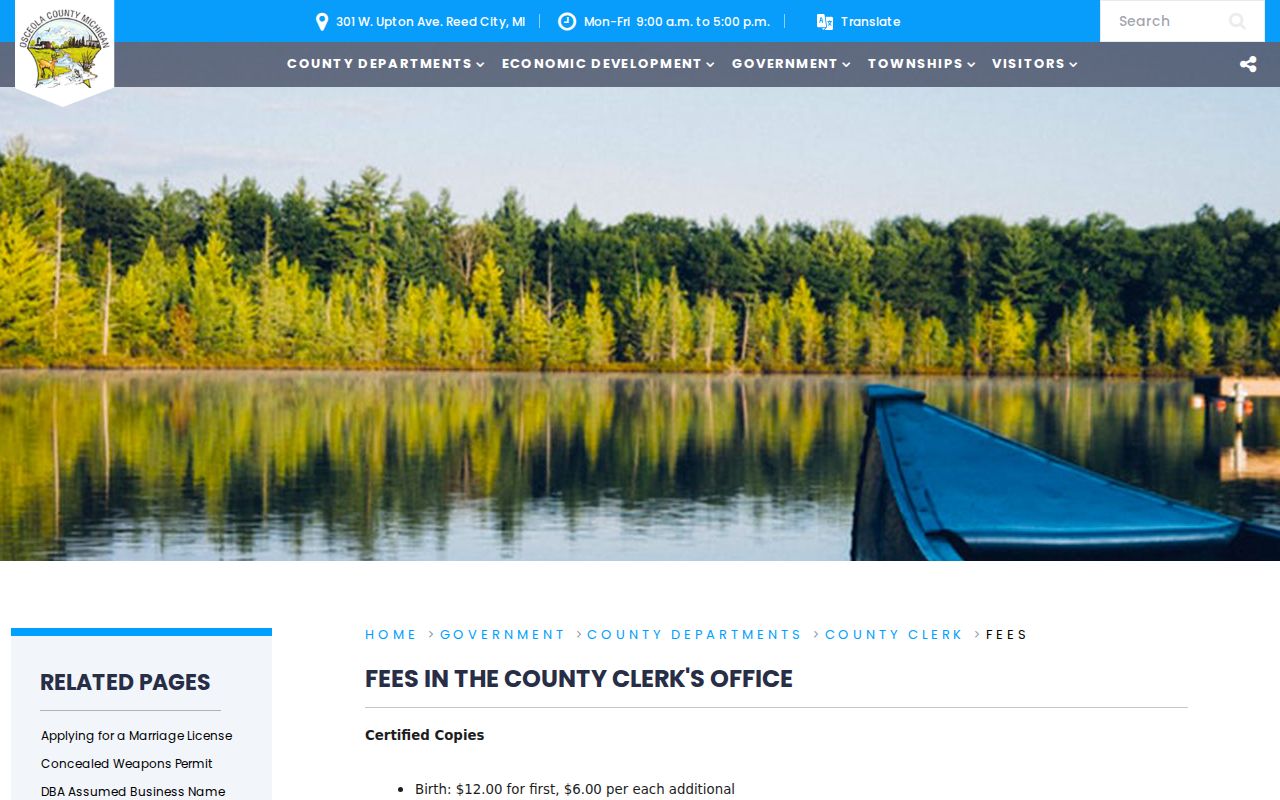
The clerk's own fee schedule treats a search, a per-page copy, and certification as three separate charges. Reading them as one price is a mistake the docket page helps you avoid.
Osceola County Court Records Copy Choices
Looking at a public case history costs nothing and proves nothing. MCR 8.119 allows public inspection of public court records and permits reproduction fees. Michigan records standards say a court may charge reasonable reproduction costs. It may not charge merely for accessing a public case history or retrieving and inspecting a public document. A certified copy matters only in one situation. It counts when the receiving court, agency, or transaction demands the clerk's official certification.
Some items never pass through the ordinary copy counter. A transcript follows the court reporter and transcript process instead. The state standards cite a transcript-copy charge limit. But the Osceola County Clerk publishes no current transcript delivery fee, audio-recording fee, exemplification surcharge, or apostille fee. Ask before you pay. That applies whenever the item falls outside a register, order, judgment, or ordinary copy.
Sealed Records and Public Access
MCR 8.119 is the core Michigan trial-court access rule. It recognizes a public case history while letting records covered by an order stay nonpublic. So a docket event can be visible even when its attachment is restricted. Ask the clerk three things. First, whether the case history is public, whether the document can be inspected, and whether a plain or certified copy can be issued.
Access limits to expect: MCR 1.109 protects personal identifying information. Juvenile records are generally not open to the public under MCL 712A.28. Adoption, mental-health, name-change, will, PPO-related, and other restricted matters may be absent from a public MiCOURT search.
A city or county FOIA request is the wrong door for court records. Michigan FOIA can reach municipal administrative records. A state-court case history or document must instead be requested through the court and its court rules.
Federal Osceola County Court Records
Federal court records work on a separate system. Osceola County sits in the Southern Division. That division belongs to the U.S. District Court for the Western District of Michigan. Under the district's public-access notice, federal civil cases filed from August 1, 2001 forward and criminal cases filed from November 1, 2003 forward are kept electronically. PACER and CM/ECF are federal tools, not extensions of MiCOURT. Sealed federal material stays off the public electronic docket. The Western District public-access notice lays out the civil and criminal record paths.
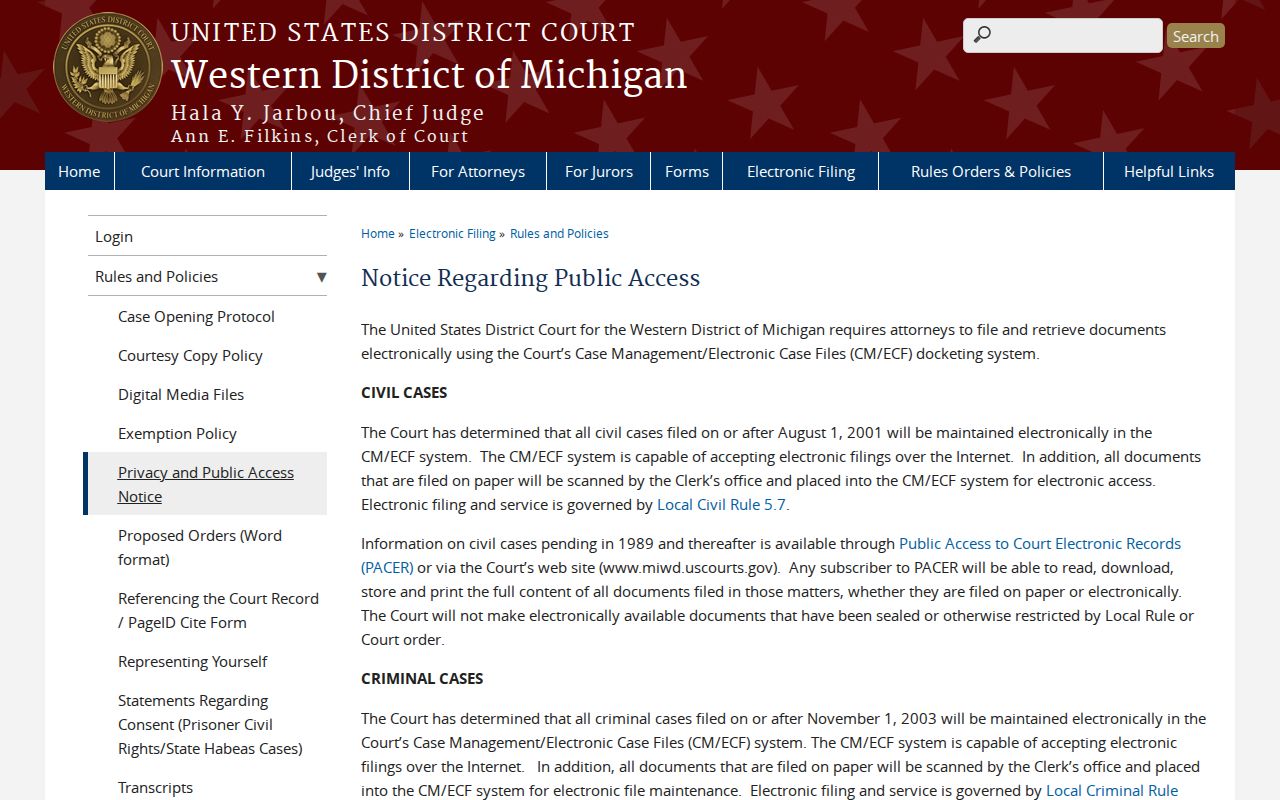
That federal notice also makes one thing plain: a Michigan state-court docket search won't produce an electronic federal docket. The systems don't overlap. The Western District Bankruptcy Court locations page lists the Grand Rapids office serving the district.
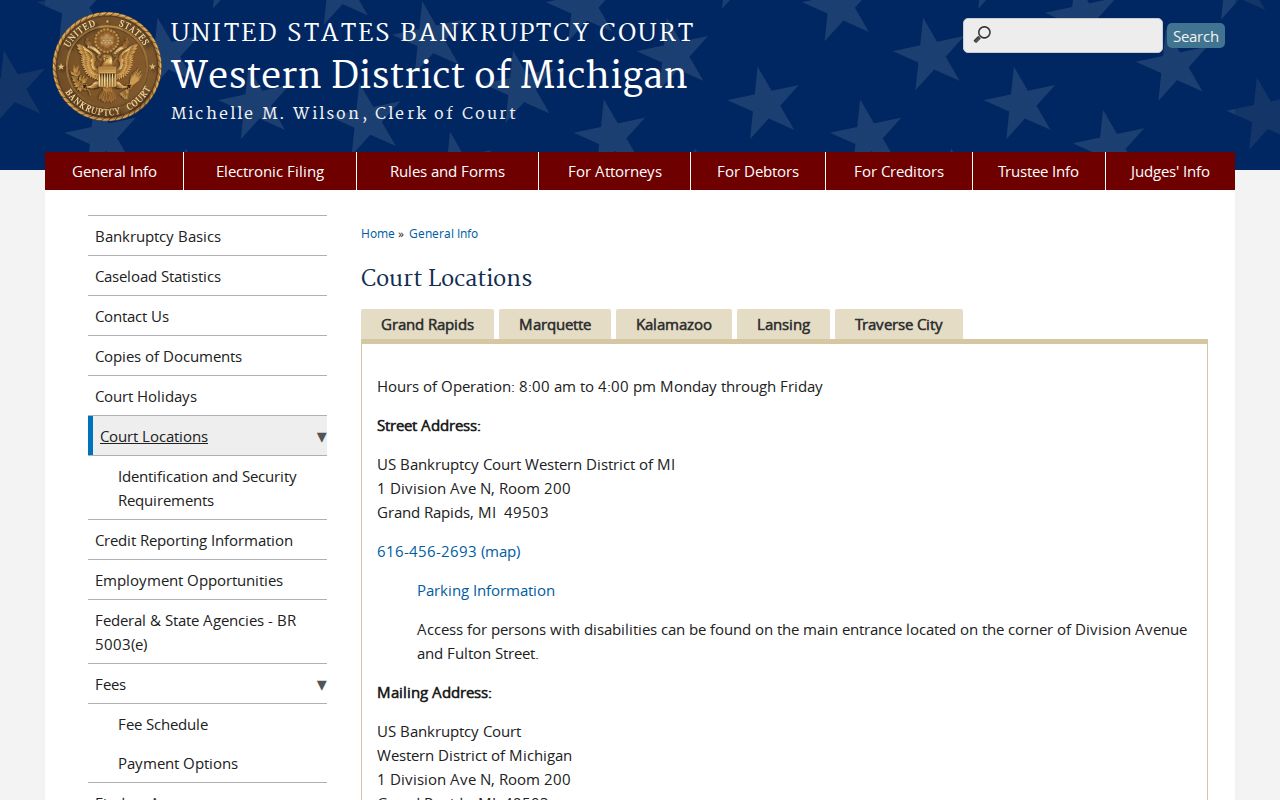
Bankruptcy files follow the federal court's own clerk and PACER route, even when the filer lives in Osceola County. The bankruptcy court copy instructions cover PACER, the clerk counter, mail, email, and fax options.
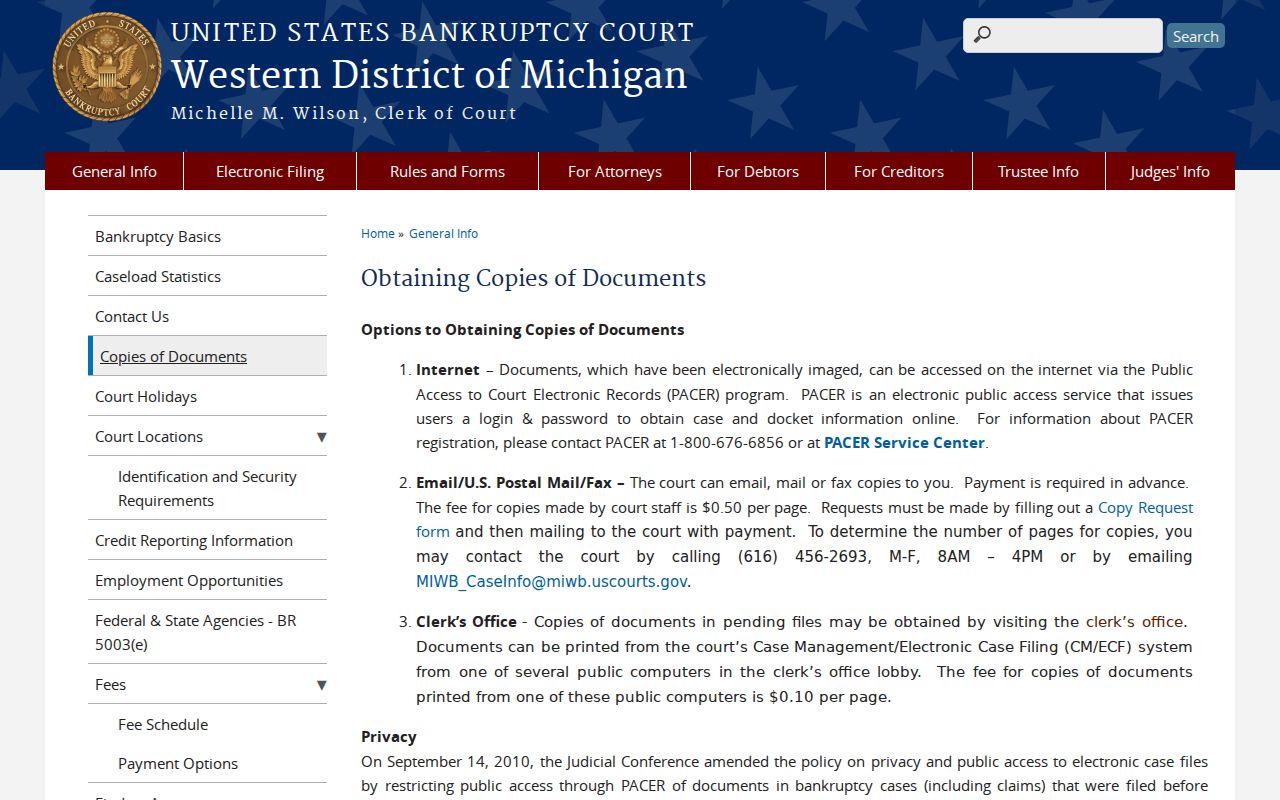
The federal bankruptcy staff-copy rate is $0.50 per page with advance payment. That schedule belongs to the bankruptcy court, not the Osceola County Clerk's state-court copy fees.