
Osceola County Court Calendars Explained
Michigan's public Court Display is Osceola County's documented date-based calendar tool. Pick a day and you get rows listing party name, time, room, and case number. It answers one question well: what is set on that date. It is not the official case file, though, and it is not a certified calendar. A row may be missing for several reasons. The matter could be sealed, restricted, moved, handled remotely, or simply kept out of the public view.
The counters behind Osceola County court matters differ. The 77th District Court handles several case types. It takes traffic, many misdemeanors, civil infractions, small claims, and district civil cases. Circuit and family work runs through the shared 49th Circuit Court. Meanwhile Probate District 18 keeps the probate and juvenile records. When you actually have to appear, no public screen is enough. Get a direct confirmation from the right clerk, register, or Friend of the Court office.
Note: a calendar row is only a snapshot. Keep the newest notice, and check with the court of record before you travel.
Osceola County Court Display
The MiCOURT public Court Display works by date navigation rather than a county daily PDF. Jump to the date you need. Scan the setting rows. Then copy down the case number exactly as shown. That number is the bridge to the public case-history search. A matching party name is just a search cue. It never proves a row belongs to a specific person.
The calendar will not give you the full history of a dispute. Plug the number into the MiCOURT Case Search where the public record is available. Compare the court, case type, year, and status. For an official answer about a setting, the clerk is still the source. The portal itself warns that its results are informational. They do not replace the court record.
A public Court Display capture shows the date controls. It also shows the party, time, room, and case-number columns as they appear for any visitor.
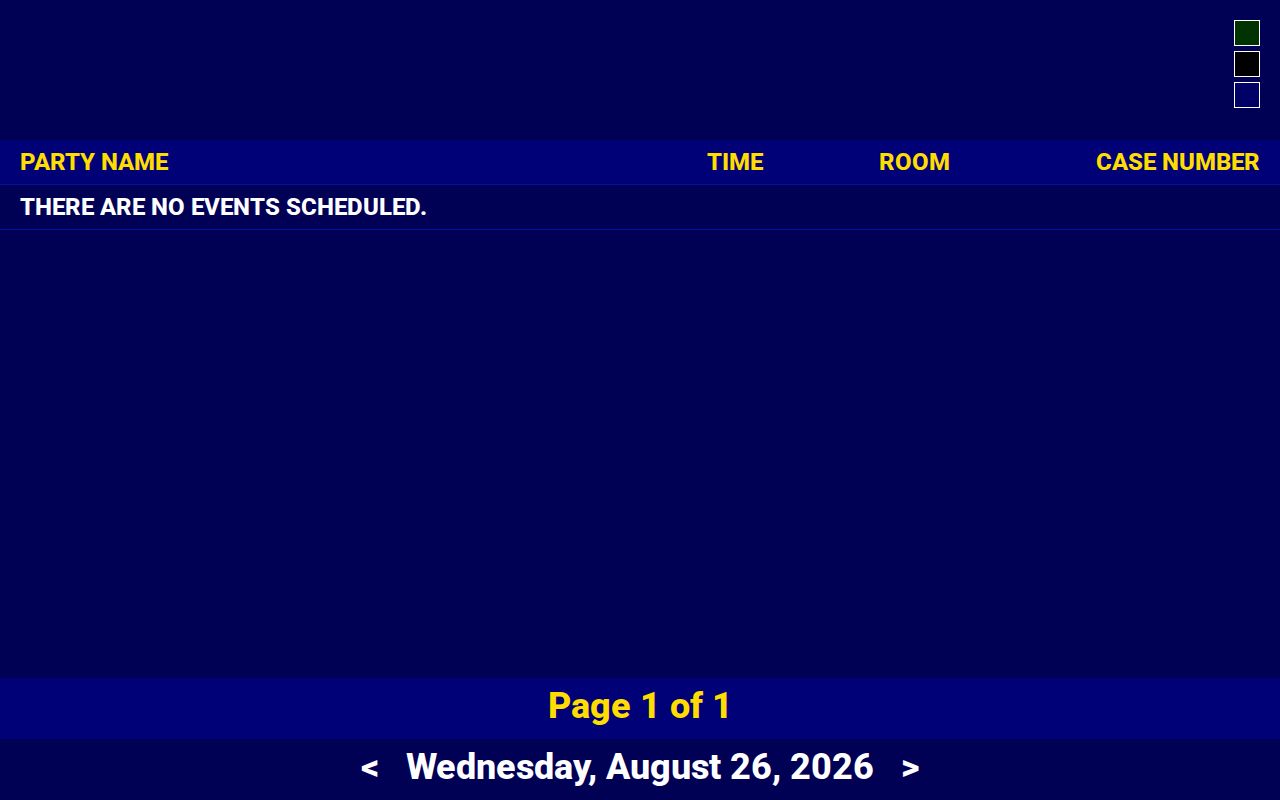
Those fields will point you to an Osceola County court date. The screen still cannot certify the event or promise the setting has not changed.
Finding Your Court Date
Start with the newest summons, citation, notice, or order. It often carries the date and court before any online search is needed. Have no notice? Use the calendar by date. Use the case-history search by name or case number. Never enter protected identifiers into a general search. Michigan rules shield full dates of birth, license numbers, financial-account data, and Social Security numbers.
- Check the paper notice or citation for the case number, court, response deadline, and any appearance instruction.
- Open the public Court Display and navigate to the expected date. Record the time, room, and case number from a matching row.
- Use MiCOURT Case Search to compare the court, year, type, status, and case history when that public record is indexed.
- Call the division that holds the case. The 77th criminal clerk is the route for criminal settings, the civil clerk for civil and small-claims settings, and the traffic clerk for citations.
- For circuit or family matters, contact the 49th Circuit or County Clerk; use the Probate Register for probate matters and the Friend of the Court for its conferences or referee settings.
- If online results conflict with a notice, ask the clerk which setting is current and whether a courtroom posting or docket call supplies further instructions.
The County Clerk and the 77th District Court publish no daily printed calendar, no text reminder system, and no complete recurring schedule. That gap matters. A missing calendar row neither cancels a notice nor extends a deadline. Confirm locally through the clerk, the counter, or counsel.
Osceola County Court Calendar Channels
Match the channel to the case. The 77th District Court runs separate criminal, civil, and traffic clerk routes, so a traffic citation belongs with the traffic clerk rather than a general circuit request. Circuit and family matters go through the 49th Circuit and the County Clerk. Probate District 18 has its own register. Friend of the Court conferences and referee matters get confirmed with that office directly.
77th District Court
Traffic, criminal, civil, small-claims, and civil-infraction settings use the district-court division that fits the case.
(231) 832-6155
301 W. Upton St., Reed City. Posted hours are Monday through Friday, 8:30 a.m. to 4:30 p.m.
Your attorney is another route. Counsel may receive a filed notice or a change before any public calendar refreshes, so a represented party should ask counsel to confirm the setting instead of trusting a visible row to hold every instruction. Osceola County offers no local reminder program. Do not sit around waiting for a text or email the court never promised to send.
How to Read a Court Setting
A court setting is the scheduled event shown in a calendar or case history. The public display exposes only a limited set of fields. Read them together. A room tells you where to go. It does not tell you whether a check-in, screening, video link, or other arrival rule applies. A time is the scheduled start. It is never a promise the matter gets called at that exact minute.
| Date | The scheduled day for a hearing, conference, motion, or other event. Confirm it against the newest notice because it can move. |
|---|---|
| Time | The listed start time. Arrival, security, or check-in instructions can be different and should come from the court or notice. |
| Room | A courtroom or location identifier. The public display may not provide floor, entry, or remote-appearance details. |
| Party name | A search cue only. Compare the case number, court, and type before relying on a row. |
| Case number | The precise link to the related public case history. Keep its year, number, and type exactly as displayed. |
| Setting type | The purpose when it is exposed, such as a hearing or conference. Not every public row supplies a full description. |
Osceola County Court Setting Fields
Calendar words describe an event, not its outcome. Reading them plainly keeps you from missing a task. The 49th Circuit family material and the joint family-court plan add one more reason to confirm with the correct office: circuit and probate work share a family-division framework, while the calendar record can still be held or routed by a particular court.
- Setting
- A scheduled court event, such as a hearing, conference, or motion date.
- Continuance
- A court-approved move of a setting to a later date or time.
- Reset
- A replacement setting after the original event is moved, often reflected by a new notice or case-history entry.
- Cancellation
- An event that no longer appears as scheduled. Confirm the reason and next step with the clerk.
- Case history
- The chronological record, also called a register of actions, that the clerk maintains under MCR 8.119.
Not everything reaches the public screen. MiCOURT keeps certain case types out of public view, among them juvenile, adoption, mental-health, PPO, will, and some family matters. So a blank spot on the calendar can mean a protected record, not an empty docket.
Continuances, Resets, and Cancellations
Calendars go stale. A hearing listed on the public calendar today can be moved, held by video, or left off the public view entirely after you check it. So confirm any continuance, reset, or cancellation through the clerk, a fresh notice, or the case-history entry itself. An old entry alone is not a safe basis for deciding whether to appear.
When a date changes, ask plainly: which event moved, and what are the new date and time? Which court or room now holds it? Is any filing due before that hearing? Hang onto both the original notice and the new one. Never build a replacement date from an old entry. That risk grows if the case number or court has changed.
Note: the county pages offer no direct Osceola calendar deep link, no recurring assignment chart, and no public reminder service.
Osceola County Court Calendar Gaps
Online tools are not a full file room. MiCOURT Case Search works as an informational index; Court Display is only a calendar view. Public civil, traffic, criminal, domestic, and probate matters may appear. Yet the fields and filters shift with each court and record type. The county posts no separate Osceola docket-search address or public terminal URL.
Work the chain instead. Start with the public date display. Then use public case history when offered. Then contact the clerk handling the case. Requests for a filed register of actions, a certified record, a transcript, or a document go to the clerk. MCR 8.119 governs inspection and copying of Michigan trial-court records. MCR 1.109 requires protected information to be redacted or kept nonpublic.
If You Miss a Court Setting
Move quickly if you miss an Osceola County setting. Keep the notice. Find the case number. Call the clerk for that division, and ask whether the hearing went forward, was continued, or was cancelled, and what comes next. Rules differ across criminal, traffic, family, probate, and civil cases. The clerk explains process but cannot give legal advice.
Missed a Setting? A missed date can carry serious consequences, including a failure-to-appear issue or another court response, depending on the case.
Contact the relevant clerk or an attorney immediately, and do not assume that an older Court Display row reflects the current setting.
For a traffic civil infraction, MCR 4.101 governs citation responses and defaults; use the citation and court notice for the specific procedure.
Osceola County Court Date Settings
Family cases carry a local wrinkle. The 49th Circuit Court and Probate District 18 run a shared family division. It operates under the Mecosta and Osceola Family Court Plan, built on a one-family, one-judge framework. A family conference, referee matter, or probate-related hearing should therefore be confirmed with the specific court office, register, or Friend of the Court. Do not guess from a general calendar.
County materials point to virtual courtroom appearance instructions for the 49th Circuit page within county navigation. No direct static link is posted. So verify any video setup with the court itself. For in-person settings at the 77th District, the county court page lists conduct limits. These cover electronic devices, photographs, disruptive noise, food, and general courthouse behavior. Disability accommodation details are also available through the court page.